
Key findings of the report
Solar photovoltaic (PV) technologies are central to more equitable electricity access and decarbonisation. This is particularly true in Low- and Middle-Income Countries (LMIC), where decentralised renewable-energy systems play a critical role while grid expansion remains slow. However, the rapid scaling of PV deployment is causing a future safety, environmental and governance challenge that remains poorly understood in LMIC contexts: the safe and sustainable management of PV infrastructure at end of life (EoL).
This report presents a high-level review of photovoltaic end of life systems in Low- and Middle-Income Countries. It synthesises findings from a structured literature review and in-depth case studies from Malawi, Rwanda, Kenya, India, and Nepal, selected to represent a range of PV market maturities, deployment models and institutional arrangements.
Why do we need to plan for solar end of life?
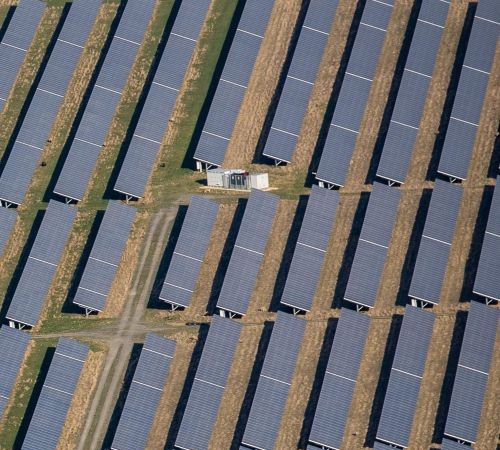
Global PV deployment has expanded rapidly, with over 2.26 terrawatts installed worldwide by 2025 and projections of 15.5 terrawatts by 2050 [1]. While the majority of installed capacity is in higher-income countries, PV markets in LMICs are growing quickly across utility-scale, commercial and industrial, and off-grid segments. In Africa and South Asia in particular, decentralised and off-grid solar systems such as solar home systems or pico-solar products (such as solar lanterns) have been instrumental in extending electricity access to hundreds of millions of people.
These deployment pathways affect end-of-life management. Off-grid and small-scale PV systems are geographically dispersed, often short-lived and characterised by fragmented ownership and limited asset tracking. Batteries and electronic components frequently fail well before PV modules, generating early and hazardous waste streams. At the same time, a large but mostly unplanned future wave of PV module waste is emerging from commercial and industrial and utility-scale systems installed since the mid-2010s.
What will happen if we do nothing?
The report warns that unmanaged or poorly managed PV EoL systems create multiple, interlinked risks:
What are the system-level gaps?
The report identifies a consistent set of system-level gaps across LMIC contexts, spanning policy, institutional, economic and technical dimensions:
- Limited operationalisation of PV-specific EoL policy, even where broader e-waste or renewable energy frameworks exist. Policies are often declarative rather than accompanied by implementing regulations, standards or enforcement mechanisms.
- Fragmented institutional mandates, with unclear allocation of responsibility across ministries of energy, environment, trade, standards authorities, and local government, leading to coordination failures and weak accountability.
- Weak reverse-logistics and aggregation systems, particularly for rural and off-grid markets. There are few structured pathways linking dispersed users to safe collection, preprocessing, and downstream recycling or refurbishment.
- Insufficient data and traceability, including limited visibility of installed PV stock, system lifetimes, component failure rates, and projected waste volumes. This constrains forecasting, investment planning and policy design.
What are our recommendations?
While there are significant challenges for EoL management, the report finds opportunities to take action on priority challenges:
- Extend product lifetimes: through quality enforcement, maintenance and repair ecosystems, refurbishment centres, and life-extension hubs. This reduces waste volumes while creating local technical employment.
- Pilot modular collection and pre-processing systems: Build on existing infrastructure such as municipal transfer stations, WEEE centres, installer networks and solar service hubs. Early-stage aggregation and safe dismantling can be prioritised before full recycling infrastructure is developed.
- Strengthen data and system visibility: By linking PV import data, installation licensing, standards certification, and asset registries to EoL planning and forecasting tools. Foundational data systems are a prerequisite for later regulatory enforcement or EPR implementation.
- Phasing EPR proportionately: Begin with reporting, registration and collection obligations, and gradually increase material recovery requirements as technical and institutional capacity matures.
- Embed EoL planning into deployment programmes: Leverage donor and development-bank conditionality to require asset tracking, safe storage and EoL budgeting at the point of installation.
- Develop regional or shared treatment pathways: Where domestic recycling is not economically viable, use these pathways to achieve economies of scale while maintaining environmental safeguards and social protections.
Explore the five case study countries in more depth
Acknowledgements
This report was commissioned as part of the Engineering X Safer End of Engineered Life programme. The report was developed and coordinated by Equal Access Energy in partnership with Ajummery Bikas Foundation, Audax Consulting, and E[co]work.
Lead authors:
- Aran Eales, Equal Access Energy
- Damien Frame, Equal Access Energy
- Tash Perros, Audax Consulting
- Nawaraj Sanjel, Ajummery Bikas Foundation
- Subarna Kapali, Ajummery Bikas Foundation
- Deepali Sinha Khetriwal, E[co]work
We would also like to thank NEPC Reviewers and Academy staff for their contributions to this publication.